

Established in 2016, ENECOLAB is an Italian R&D company focused on finding innovative solutions to improve the eco-compatibility of production processes, with the aim of ‘zero waste.’ The goal is to produce new raw materials and energy from end-of-life materials that are non-reusable, non-recoverable, non-recyclable.
ENECOLAB’s GEOW® (Green Energy from Organic Wastes) technology is a patented thermochemical process to convert a material containing available carbon into syngas and inert residual solids. ENECOLAB has obtained seven patents, two others are pending, and three more will be applied for. The lab has several reactors (two lab-scale, anaerobic pyrolysis, up to 850°C; one lab-scale, gasification, up to 1,050°C; one industrial-scale, anaerobic pyrolysis; one industrial scale, gasification).
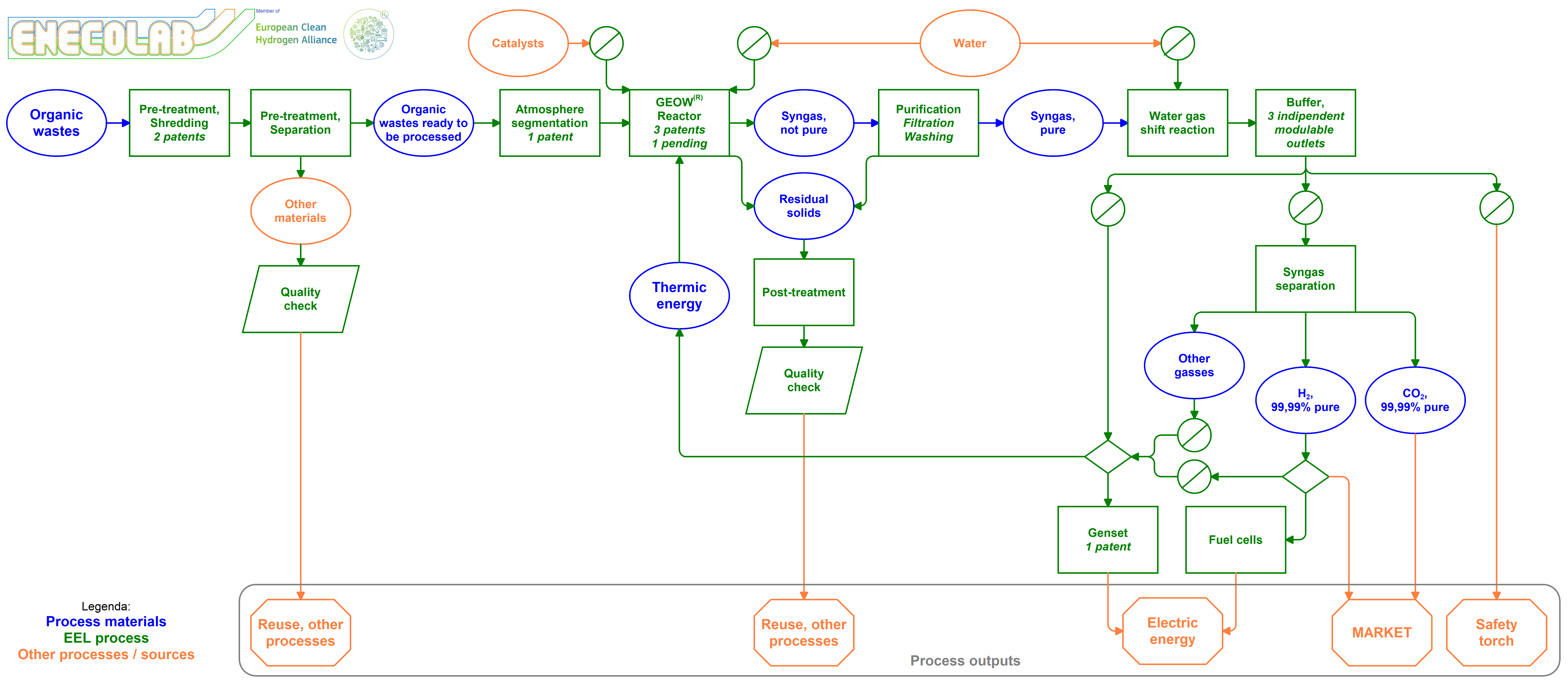
ENECOLAB’s GEOW® process.
ENECOLAB has strong relationships with the University of Trieste (Italy) and other research institutions. The first experimental plant that will convert 1,450 t/year of industrial wastes, generated by HPL production, into syngas (reducing the energy requirement of the plant by 25%) and by-products (200 t/year of by-products) is under construction and will start operation in the Spring of 2025, with a positive thermic energy balance. Later in 2025 a new lab will open in Turin, starting a cooperation with Istituto Italiano di Tecnologia and Politecnico di Torino.
ENECOLAB’s role in REFRESH
ENECOLAB is participating in Work Package 1: Design of portable dismantling, shredding and sorting technologies, which is developing technologies to cut and shred the turbine blades and sort the resulting materials for recycling. Using its thermochemical technology, ENECOLAB will convert the dust and fines produced during these processes into energy and by-products.
We spoke to Renzo Biasi, the company’s CEO, and Lucio Marquardt, CTO.
What is ENECOLAB’s experience in the composites sector?
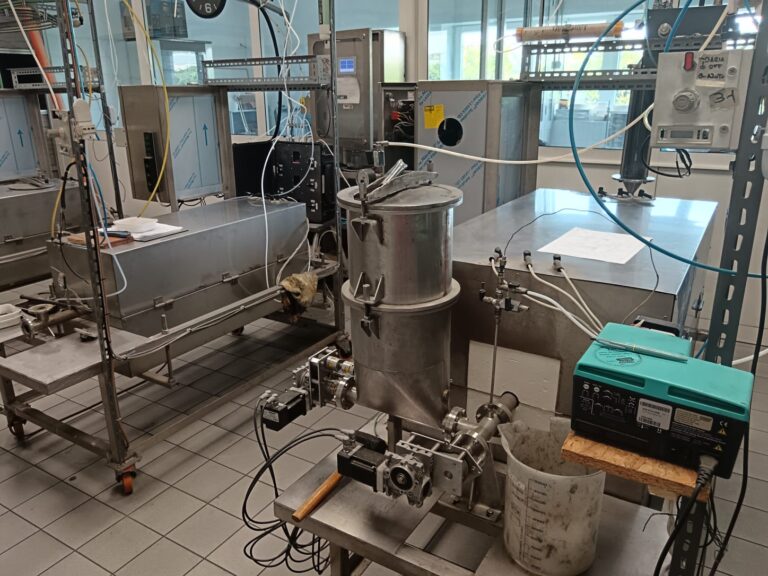
The ENECOLAB laboratory.
Several years ago, we were involved in a boatyard: as we were improving the eco-compatibility of the production, we became aware of the end-of-life challenge of the FRP boat, starting to define possible ways of solution. In 2016 we established ENECOLAB, dedicated to this issue. We started operations in 2017, showing the first research results in a convention at Trieste University in 2019.
What attracted ENECOLAB to the REFRESH project?
We were attracted by the possibility to be part of a team with an optimal mix of competences, focused on the EoL of the same material, with a wide range of possible solutions, contributing to the project to solve the last step of the sequence, the dust and fines.
What materials is ENECOLAB treating?
In the REFRESH project we are involved in the treatment of the material produced by the previous steps of the chain that can’t be used or recycled in any way – the portion with a granulometry under 3 mm.
This portion has a granulometry much too small to be used in the production of panels, and it makes no sense to try to extract the fibres as their length is micrometrical.
In simple terms, how does your technology work?
The core of GEOW® is an anaerobical thermochemical reaction: heating the material, the organic components degrade from longer to shorter molecular chains, generating a syngas and a char (the residual solids of the reaction). This degradation is proportional to the heating (the higher the temperature, the higher the syngas production and the lower the presence of polluting components in the char) and to the process condition.
In terms of environmental impact, the process is totally neutral, with no emissions to the atmosphere and no waste at the end of the process.
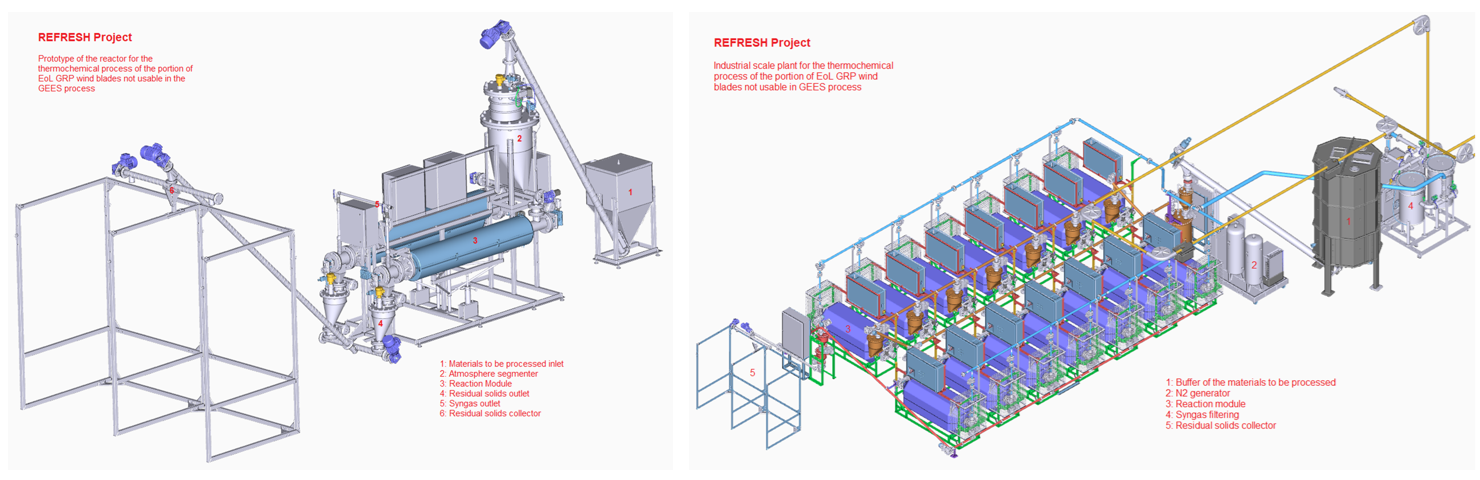
The ENECOLAB prototype reactor and industrial plant for the REFRESH project.
Are you finding any challenges for your technology in the REFRESH project, and how are you solving these?
The first challenge is the presence of glass fibres, with a micrometric diameter, that melt at a temperature lower than the optimal one for the process. Consequently, the char is not totally inert. We have acted on two fronts, finding the best compromise between temperature and quality of the reaction, and searching for methods to reduce, hopefully to zero, the polluted portion of the char (adding catalysts to the materials before the reaction, adding a post-reaction phase, etc.).
The second challenge, according to the prevalence of inerts (the glass fibre) over the organic ones (the resin), was to optimise the thermal part of the process, reducing heat dispersions, to have a positive thermal balance (generated thermic energy on used thermic energy).
The third challenge was the inhomogeneity of the material: different resins and different proportions of resin to fibres deliver a different result. So we have focused on finding a standard able to ensure the feasibility of an industrial process.
The fourth challenge was to define an optimal reactor to process this material, acting both on the geometries (according to the kinetics of the reaction) and on metallurgy.
What do you hope to have achieved by the end of the project?
We hope to be part of the industrial value chain that can arise from the REFRESH project, setting to permanent the project partnership.
For further information visit the ENECOLAB website.
Read about our other partners:
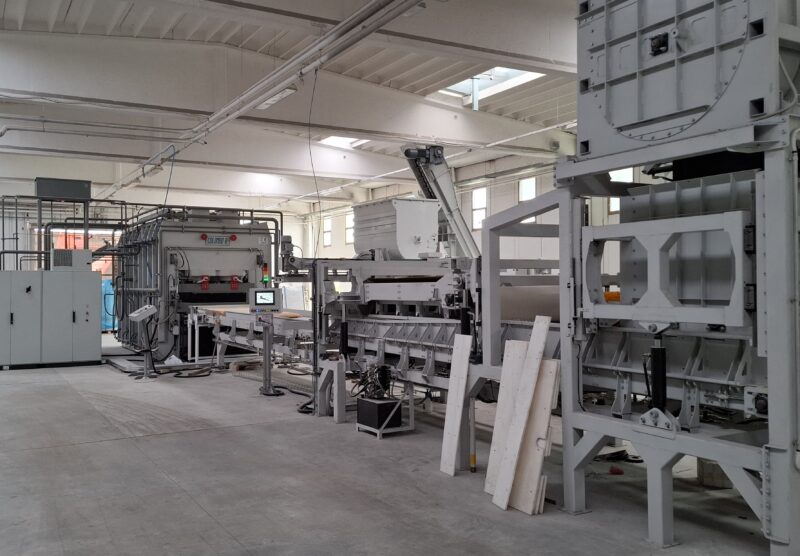
REFRESH participates in WindEnergy Hamburg as member of Wind Innovation Cluster Hub
REFRESH at WindEnergy Hamburg 2026